Knee Taping for Pain: How It Works + When Tape Isn't Enough
If your knee hurts when you walk, squat, use stairs, run, or exercise, knee taping may give you some quick relief while you work on the reason your knee is hurting in the first place.
One technique I frequently use is called a medial patellar glide. It gently guides your kneecap toward the middle of your knee and holds it there with tape.
It can be especially helpful if you have:
Pain around or behind the kneecap
Pain along the outside of your knee
Pain with squatting or stairs
A feeling that your kneecap isn't tracking smoothly
Swelling around the kneecap
Knee pain that improves when you manually move the kneecap inward
The important part: taping is a tool for changing how your knee feels and moves right now. It isn't necessarily fixing the reason the problem developed. Take the First Step Toward Lasting Relief →
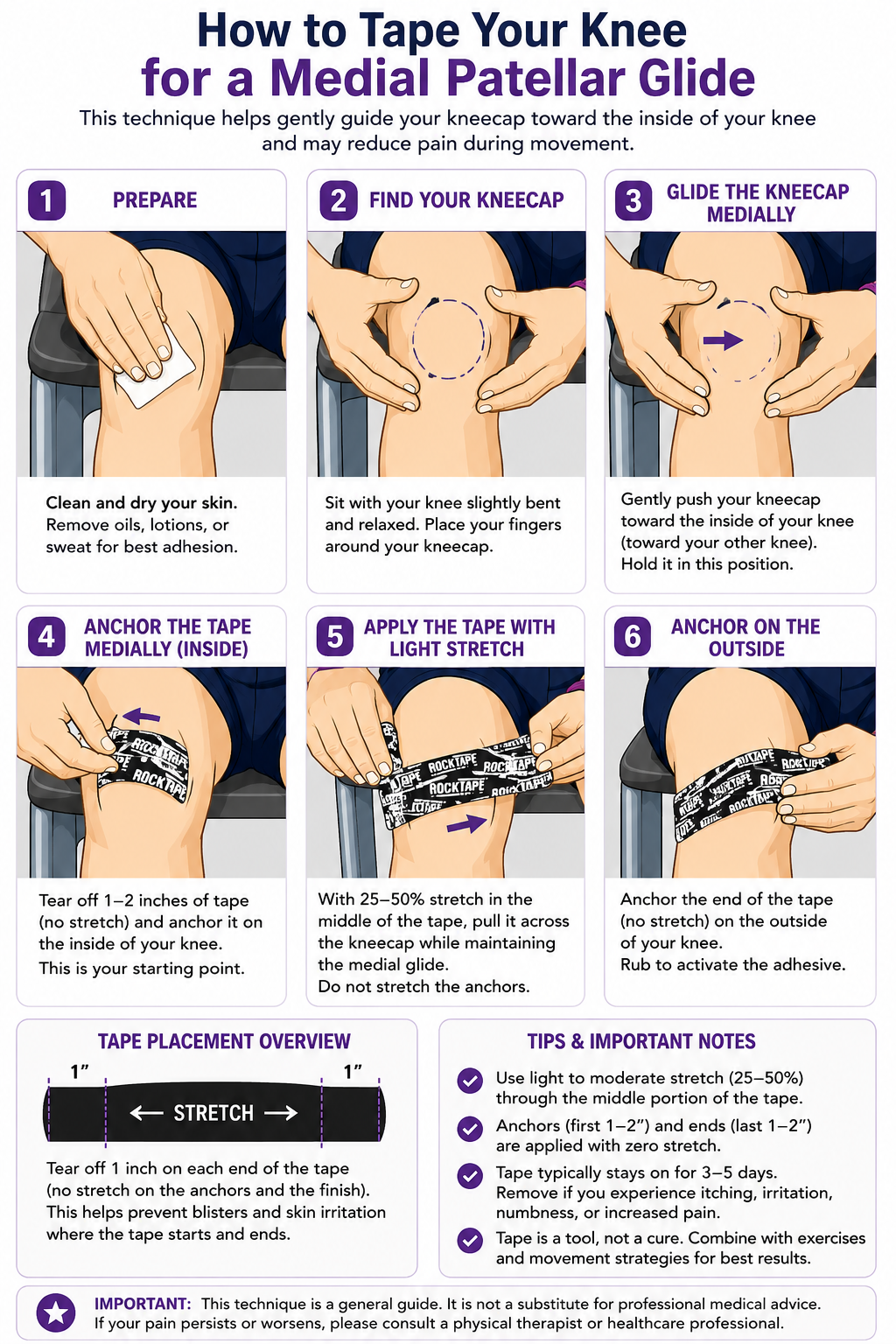
Now Test It!
Stand up and try the movement that normally bothers your knee.
For example:
Bend and straighten your knee
Does it feel easier?
If your pain or movement improves with the tape, that's useful information. It suggests that changing the way the kneecap is being loaded may be influencing your symptoms.
Does the tape help—but the pain keeps coming back?
That's often the point where another tape technique or another stretch isn't the answer. Your knee may be compensating for how your hip, foot, trunk, or other parts of your movement system are working together.
I've created programs that help you retrain how your body moves—not just give you another list of exercises.
Start the first lessons FREE →
Why Can Moving the Kneecap Change Pain?
Kinesiology tape doesn't work by holding your knee together. Instead, it provides gentle sensory feedback that increases your awareness of how your leg is moving. Think of it as a reminder that helps your brain recognize when your body begins falling back into compensatory movement patterns.
For many people with patellofemoral pain syndrome (runner's knee) or hypermobility spectrum disorders (HSD), the knee isn't the primary problem. The knee is often responding to changes in how the hips, trunk, and lower leg are working together.
Tape may temporarily reduce discomfort by holding the patella or knee cap in the right place for it to glide smoothly up and down as you move and improve confidence with movement, lasting improvement comes from restoring efficient movement patterns and progressively strengthening the muscles that support the entire lower extremity.

Your kneecap sits in a groove at the end of your thigh bone (femur).
When you straighten your knee, your quadriceps (blue arrow) contract and pull the kneecap upward (yellow arrow).
When your knee bends, the quad lengthens and stretches and your knee cap gets closer to the femur.
Ideally, the kneecap should glide smoothly through this groove as your knee moves.

The outside portion of the femur is shaped differently from the inside, so changing the position of the kneecap can sometimes reduce pressure or friction on irritated tissues.
That's why a simple taping technique can occasionally make a surprisingly big difference.

If your quad is tight, your hip is weak , or both, your knee cap tends to get pulled to the shallower, outer edge of the femur and can:
Grind on the bone (yellow arrow in the picture above)
Rub or cause friction in the tissues on the outer end of the knee
Cause increased pull or strain in the tissue on the inner end of the knee
Your Knee Doesn't Work Alone
One of the most common findings I see in the clinic is that painful knees are often the result of the body borrowing stability from the wrong muscles. Tape can make it easier to recognize these compensations while practicing healthier movement. As your awareness improves, many people find it easier to activate the muscles that provide active stability instead of relying on compensatory tension to keep the body upright.
Why was your knee struggling with that load in the first place?
Your body, foot mechanics, and overall movement strategies all contribute to how forces are distributed through your knee. With knee pain syndrome, many people gradually develop compensation patterns that rely heavily on the hip flexors, hip rotators, and hamstrings to stabilize the leg. While these muscles are important, they are not designed to do the majority of the work during walking, squatting, climbing stairs, or running.
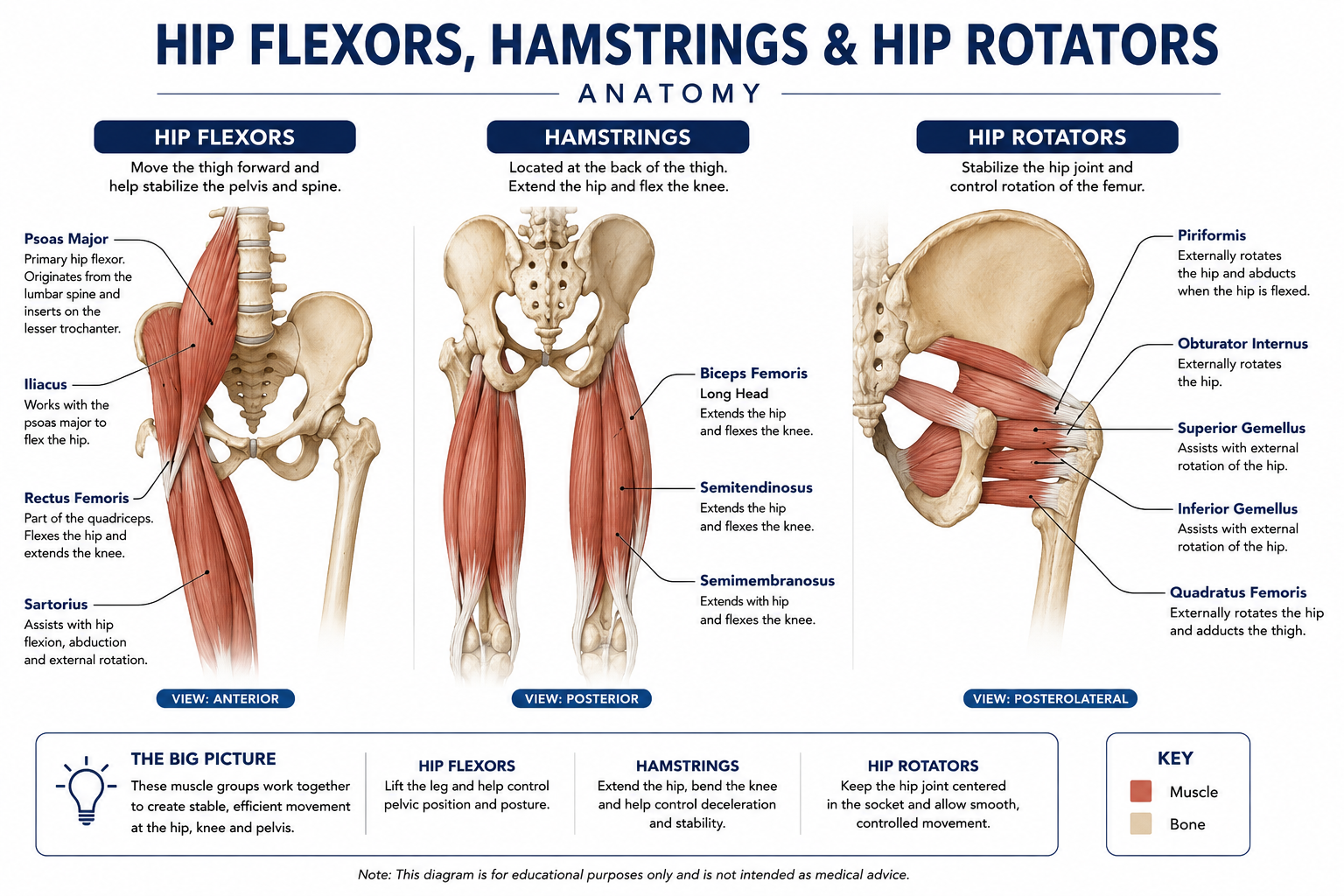
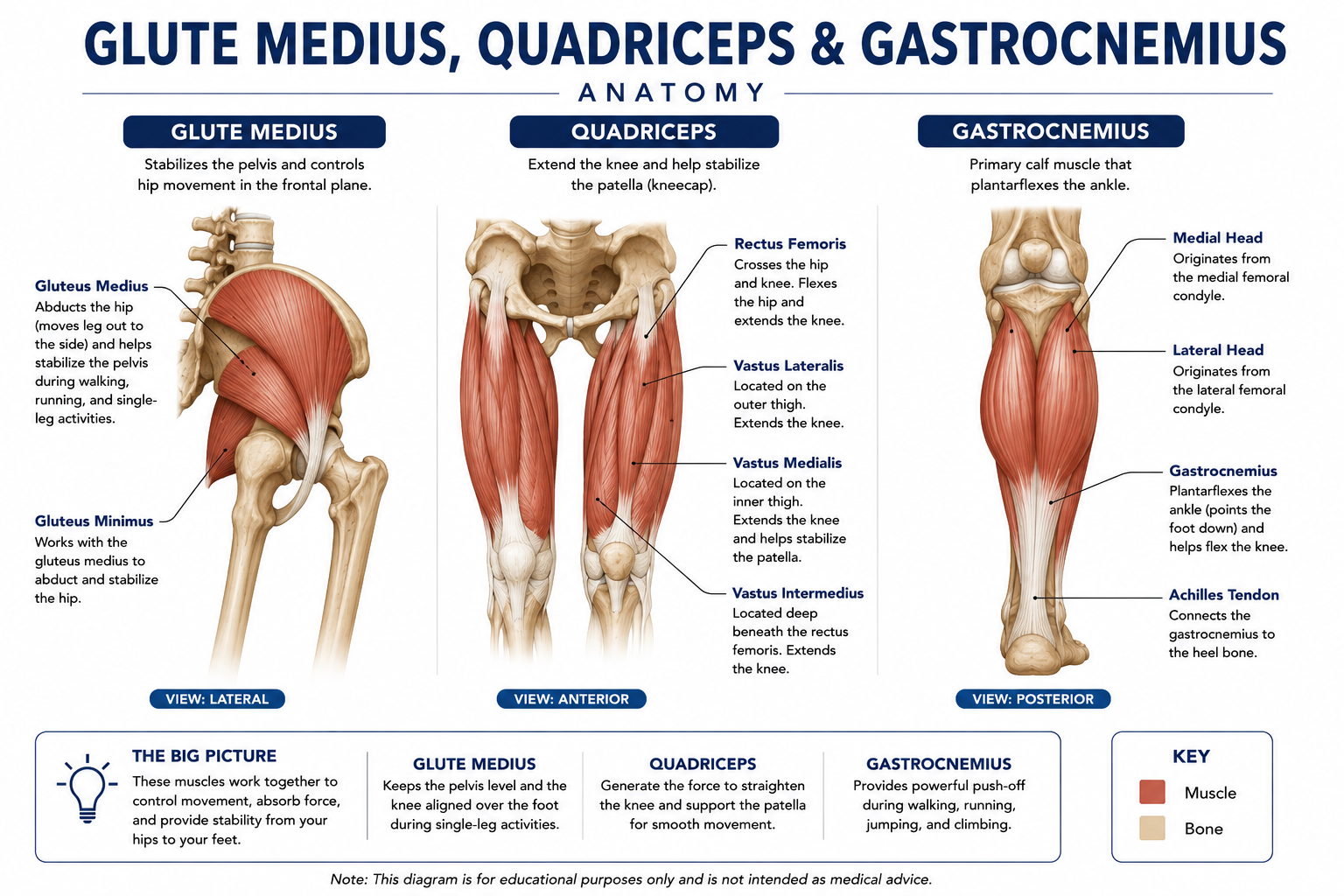
As these compensation patterns become more established, the gluteal muscles, quadriceps, and calf muscles (gastrocnemius and soleus) often contribute less effectively. Instead of the workload being shared across the entire leg, excessive forces become concentrated around the kneecap and surrounding tissues, increasing irritation and pain.
Hypermobility and Knee Stability
For individuals with hypermobility spectrum disorder (HSD) or hypermobile Ehlers-Danlos syndrome (hEDS), these compensation patterns can become even more pronounced. Because the connective tissues provide less passive stability, the brain often responds by increasing muscle tone in the hamstrings and hip muscles to help stabilize the joints.
While this strategy provides short-term stability, it often encourages excessive hip hinging and reduces the normal contribution of the glutes, quadriceps, and calves. Over time, movement becomes less efficient, muscles fatigue more quickly, and the knee experiences greater stress with everyday activities.
Healthy Movement Restores Muscle Synergy
The goal of physical therapy isn't simply to reduce knee pain—it's to restore how the entire movement system works together.
When posture, trunk control, breathing, hip stability, and lower leg strength improve, the glutes, quadriceps, calves, and core begin sharing the workload more effectively and keep the knee tracking in the femoral groove the right way. This reduces the need for excessive hamstring and hip flexor guarding, allowing forces to be distributed more evenly throughout the lower extremity.
Tape can be a helpful tool during this process because it increases awareness of your movement. It reminds your body to practice healthier mechanics while you're retraining the muscles that provide long-term stability.
Over time, as these movement patterns become more automatic and your muscles become stronger, you'll rely less on the tape and more on your body's own active support system.